
When an independent publisher seeks to release a game on multiple platforms while producing its own cutscenes, it faces a concrete problem: building an internal team for each specialty is expensive and time-consuming. This is precisely where game and digital animation studios come into play, these structures that bring together game design, 2D/3D animation, development, and artistic direction under one roof.
Production Pipeline in an Animation and Video Game Studio
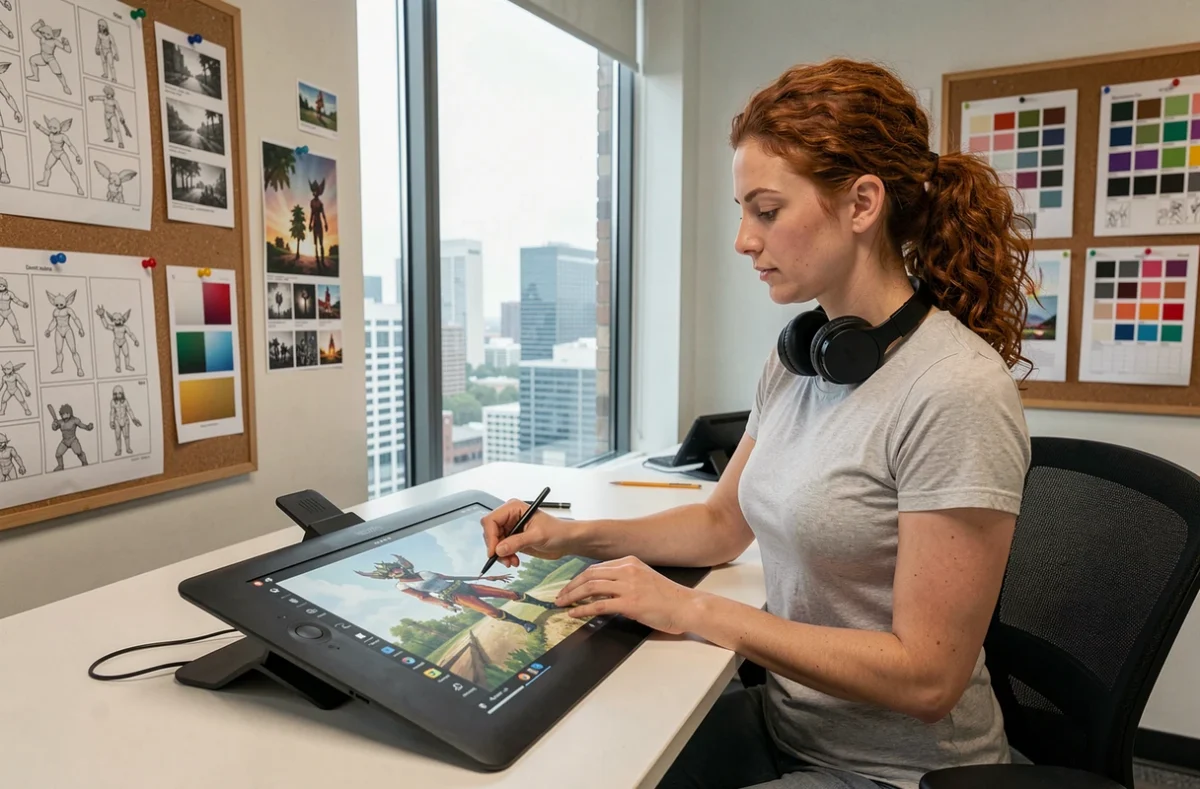
One often imagines a studio as a place where artists draw freely. The daily reality resembles a highly sequenced production line. Each step (concept art, modeling, rigging, animation, engine integration) depends on the previous one, and a delay in rigging pushes back the entire process.
Studios that offer complete creative services organize this pipeline so that the client has only one point of contact. The concept artist delivers approved boards, the 3D modeler works directly from these references, and the animator receives assets already optimized for the target engine. An integrated pipeline reduces back-and-forth between distinct service providers, compressing timelines by several weeks on a medium-sized project.
For professionals who want to learn more about Ludika Studio, this logic of integrated production illustrates well what specialized structures in playful creation and digital animation offer.
Hybrid Model: Client Services and Intellectual Property
One of the less visible aspects of the industry concerns how studios finance their activities. Many combine two sources of revenue: service missions for publishers or brands, and the development of their own games in parallel.
The services (animation for a trailer, 3D assets for a mobile game, gamification of a business application) generate regular income. Developing an in-house game retains intellectual property within the studio, with long-term revenue potential if the title finds its audience.
This dual role is not anecdotal. In France, access to funding has significantly tightened for independent studios: investors and banks have become more selective, while production cycles are lengthening. The hybrid model allows for not depending on a single funding channel, which strengthens the stability of the structure.
Creative Services Offered by a Digital Game Studio
Not all studios cover the same scope. Some specialize in cinematic animation, while others focus purely on game design. The most versatile structures offer a range of services that cover the entire creation cycle.
- Game design and prototyping: designing game mechanics, writing the design document, creating playable prototypes to validate the concept before full production
- Art and artistic direction: concept art, character design, environment design, with visual consistency maintained throughout the project
- 2D and 3D animation: from animated sprites for a mobile game to motion capture cinematics, including in-game animations (idle, combat, transitions)
- Development and engine integration: gameplay programming, integrating assets into engines like Unity or Unreal, optimizing performance according to the target platform
- Gamification of applications: transforming web or business interfaces into engaging experiences, with mechanics borrowed from video games (progression, rewards, challenges)
The choice of studio depends on the project. For a complete production, one looks for a structure capable of managing the pipeline from start to finish. For a one-off mission (animation redesign, trailer creation), a studio specialized in a specific link may suffice.
Video Game Tax Credit and Regulatory Constraints in France
The video game tax credit (CIJV) remains a significant regulatory lever for studios based in France. The scheme is extended until December 31, 2028, but it imposes specific conditions: eligible expenses capped, provisional then definitive approval to be obtained from the competent authorities.

In practice, these constraints directly influence the production schedule. A studio wishing to benefit from the CIJV must structure its contracts and development phases according to eligibility criteria. Feedback varies on this point, as administrative complexity can hinder smaller structures that do not have a dedicated legal service.
For a client engaging a French studio, this regulatory dimension can also play in their favor: studios eligible for the CIJV sometimes pass part of the tax advantage onto their rates, making the service more competitive against foreign competitors.
Generative AI in Animation Workflows
The integration of artificial intelligence into animation pipelines is a divisive topic within the profession. Some studios are already using generative tools to accelerate steps like texture generation, in-betweening (interpolating keyframes), or creating variations of backgrounds.
Productivity gains exist, but they come with concrete questions. The ownership of AI-generated content remains a legally murky area. The impact on creative employment concerns teams. And the regulatory framework is not yet stabilized, which can pose problems in service contracts where the chain of rights must be clear.
A studio transparent about its use of AI in the pipeline inspires more trust than a structure that uses it without mentioning it. This is a criterion to establish from the first exchanges with a provider.
The digital creation and video game sector in France remains driven by studios of very varied sizes, from micro-studios of three people to structures with several dozen employees. The common point among those who endure: a capacity to combine technical mastery of the pipeline, revenue diversification, and rapid adaptation to tools that transform the profession.